
Capital gains tax: a minority sport?

Will increased capital gains tax (CGT) mean less tax gets paid?

The Labour Party’s 2024 manifesto said, ‘We will not increase National Insurance, the basic, higher, or additional rates of Income Tax, or VAT.’ The absence of any comment on CGT meant that Rachel Reeves received persistent questions during the election campaign about a possible increase. Unsurprisingly, there was no definitive answer.

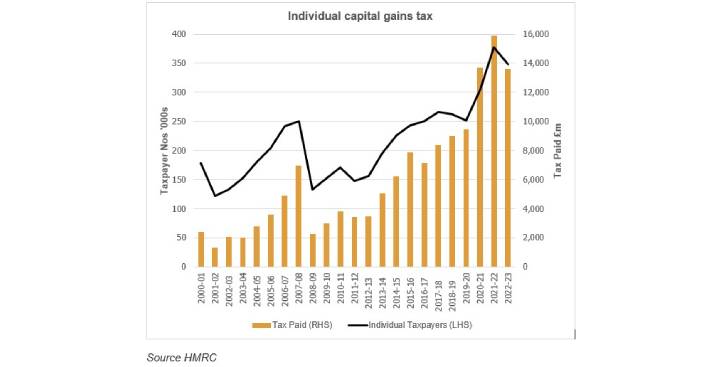
At the beginning of August, HMRC published new data about how much CGT had raised. The figures were for 2022/23, when the annual exemption was £12,300 of gains, as opposed to the current £3,000. Nevertheless, they provide some interesting information about who pays how much:

  • Only 348,000 people made enough capital gains to pay the tax. That is about 1% of the number of income taxpayers.
  • The total amount of CGT paid by individuals was £13.63 billion, with trusts accounting for another £0.797 billion.
  • 2,000 taxpayers – less than 1% of all CGT payers (who realised at least £5 million of gains) – paid 41% of all CGT collected from individuals. Another 4,000 taxpayers with gains between £2 million and £5 million paid 16% of the total.
  • There was more tax paid in the previous two tax years. Between 2021/22 and 2022/23 the Exchequer’s receipts fell by 15%.

That final bullet point deserves an explanation, because it is unusual for tax receipts to fall year-on-year, yet alone for two years. In July 2020, the then chancellor Rishi Sunak, commissioned the now-defunct Office of Tax Simplification (OTS) to review CGT. The move prompted speculation that CGT would be increased, a sentiment that was reinforced when the OTS suggested aligning CGT rates with income tax and sharply reducing the annual exemption. The predictable result was a pre-emptive rush to realise gains, boosting CGT payments.

In the event, Mr Sunak ignored the OTS proposals, although subsequently one of his many successors did take up the idea of cutting the annual exemption. As we wait to see what will be in Rachel Reeves’ Budget on 30 October, the story of CGT receipts may have provided her with an interesting lesson: hints of raising the tax are enough in itself to generate extra revenue.


Student loan threshold frozen

The student loan repayment threshold for England and Wales has been frozen at £25,000 until 2027, to the detriment of many new university students this September.

Increased numbers of UK students are going to university due to good A-level results and fewer international students, which means this freeze will now affect even more people. 

Repayment

Repayment starts the April after a graduate has left university. So, with a three-year course, this year’s cohort of students will not start repaying loans until 2028 at the earliest:

  • Freezing the £25,000 threshold – rather than increasing it in line with inflation or wages – brings graduates into the repayment net earlier than would otherwise be the case.
  • After 2027, the government may increase the threshold in line with inflation, but this will still mean a few years of fiscal drag.

Under the new repayment rules introduced in 2023, students do not start to repay their student loans until they are earning over £25,000 a year (£2,083 monthly).

Once earnings exceed £25,000, repayment is at the rate of 9% on the excess. Interest is added to the loan from day one, with the potential repayment term running to 40 years.

Self-funding

Wealthier parents will want to know whether they should be self-funding their child’s university fees and living costs, rather than taking out a student loan. However, the decision is far from straightforward given that the normal debt rules do not apply here.

For example, parents might pay the full cost of university education of approximately £60,000, but if their child never earns more than the repayment threshold then self-funding will have been a massive mistake. The problem, of course, is estimating earnings for up to 40 years into the future.

A compromise strategy is to take the full student loan, and then for parents to look at paying the loan off early after graduation. They would only do so if it looks like their child is going to have a high-earning career. However, this is complex area of pros and cons, depending very much on personal circumstance.

Guidance on repaying student loans can be found here.

Dividend allowance cut doubles taxpayers

With the dividend allowance now cut to just £500, the number of taxpayers paying tax on dividend income for 2024/25 is expected to be double what it was three years ago.

Previously set at £2,000, the dividend allowance was reduced to £1,000 for 2023/24, and to £500 from 2024/25 onwards. This reduction has had the biggest impact on basic rate taxpayers. Just under 700,000 basic rate taxpayers paid tax on dividend income for 2022/23, but this number will leap to nearly 1.7 million for the current tax year.

Tax liability

A modest share portfolio of just over £10,000 yielding 5% will now use up the dividend allowance, leaving the investor with a tax liability notifiable to HMRC. Consider this:

  • Notification requires either contacting the HMRC helpline, asking HMRC to collect tax through a tax coding change (if employed), or completing a self-assessment tax return.
  • With a basic rate of 8.75% on dividend income, the amount of tax due will often be frustratingly low given the inconvenience involved.

The average amount of tax due from basic rate taxpayers is estimated to be £385 for the current tax year; down from £780 three years ago.

Even worse will be where an investor opts for script dividends. These are still taxable despite no cash being received, so tax will have to be funded from other sources.

At the same time as the dividend allowance has been cut, the level of dividend payouts by companies has generally recovered to pre-Covid levels.

Mitigation

If dividend income exceeds the £500 allowance, some mitigating steps might be possible. The obvious move is to make full use of Independent Savings Account allowances for some current, and all future, share investments. Another approach would be to invest for capital growth rather than dividend income. Making use of the dividend allowance of a spouse, partner or an adult child by spreading a share portfolio across the family is another possibility.

HMRC’s guide to tax on dividends can be found here.