

The other gender pay gap

The gender pay gap does not disappear when work ends. If anything, it gets worse.
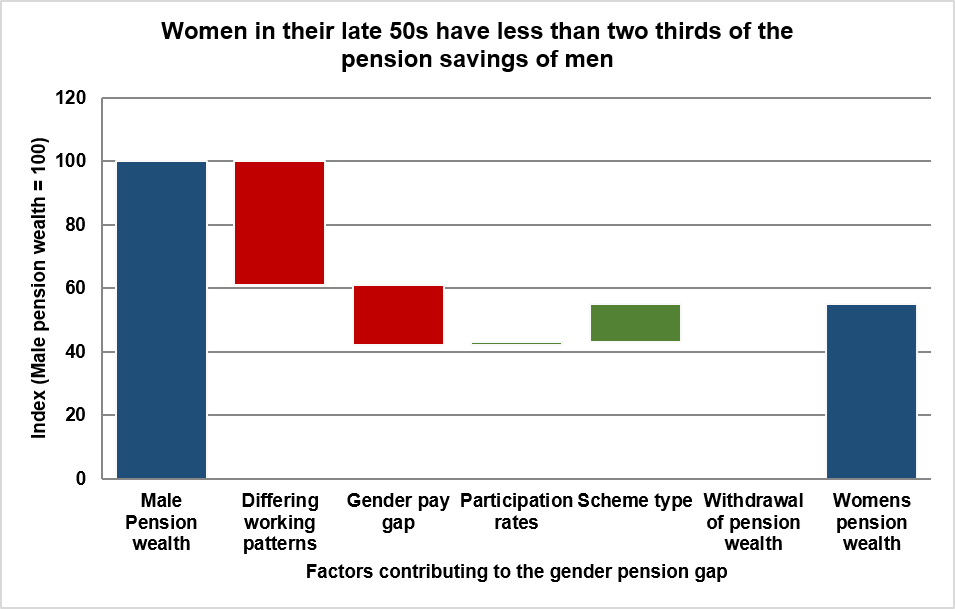
Source: PPI

How wide is the gender pay gap? The answer might surprise you. The most recent assessment from the Office for National Statistics (ONS) puts the gap for full-time employees in April 2025 at 6.9%. In 2005, the ONS figure was nearly twice as much – 13%.

However, there is another gender pay gap where the difference between the sexes is far greater – the gender pension gap. A new report from the Pension Policy Institute (PPI) has highlighted the gap – chasm might be a better description – in pension wealth between men and women in their late 50s, typically within ten years of retirement.

The graph above is based on men and women aged 57 and shows a gap of 46%. Viewed from the male perspective, this means on average a 57-year-old man has 85% more in his pension pot than a woman of the same age. The PPI attributes the yawning gap to a variety of factors, with the two main ones being:

  • Differing working patterns: The proportion of women in employment is lower than for men (75% vs 82%). Among those who are in employment, more women tend to work part-time (33% vs 10%), often because they are a family’s primary caregiver. The gender pay gap for part-time work favours women – the ONS says women part-timers earn 2.9% more than their male counterparts. The snag is that while the pay rate may be higher, total earnings are lower than for full-time work.
  • Gender pay gap: Pension contributions are normally linked to pay – contributions are often a percentage of salary. As women on the whole earn less than men, the same percentage contribution produces a smaller cash contribution and so a smaller pension pot. At low earnings levels, this can be exacerbated by the automatic enrolment rules, which exclude anyone earning up to £10,000 a year and, for those who are enrolled, ignore the first £6,240 of earnings in calculating contributions. That equates to about £500 a year of contributions (at 8%) that are not made.


If you find yourself on the wrong side of the pension gender gap, consider increasing your personal pension contributions if possible. And take advice on your overall retirement planning. Read more about the gender pay gap here.

PSC identity verification lag

Companies House identity verification is progressing reasonably well, although the latest figures show that compliance by people with significant control (PSCs) is well behind compliance by directors.

What a director, who is also a PSC, may not realise is that, although they will have a single 11-character personal code from Companies House, this code has to be provided separately for each role they hold.

Directors

Directors have been required to link their personal code with each directorship held when filing a company’s first confirmation statement on or after 18 November 2025.

  • This aspect of Companies House’s identity verification exercise is moving towards completion, with 68% of directors informing Companies House of their verified identity by 23 September.
  • Some 18% of directors, however, are overdue with their compliance.

Although identity verification may have been successfully completed, a director will still be classed as unverified until their personal code is linked to their directorship. Newly appointed directors have to provide their code as part of the appointment process.

Persons with significant control

Only 56% of PSCs had submitted their personal code by 23 September, with 26% overdue. A company’s confirmation statement cannot be submitted until all directors have verified their identity, but there is not the same requirement with PSCs:

  • Director and PSC of the same company: For the PSC role, the personal code is submitted using a separate service within 14 days of the company’s confirmation statement date.
  • PSC but not a director of the same company: The code has to be provided within the first 14 days of the PSC’s birth month. For example, if born 28 October, the 14-day submission period will run from 1 to 14 October 2026.

Individuals who become a PSC should provide their personal code within 14 days of being added to the Companies House register. Companies House guidance on identity verification can be found here.

Child Trust Funds lost in time

Almost three million Child Trust Funds (CTFs) have been claimed or transferred into an individual savings account (ISA), but around 827,000 matured CTFs remain unclaimed; worth an average £2,310 each.

CTFs were opened for every child born between 1 September 2002 and 2 January 2011, with accounts benefiting from an initial cash voucher:

  • Even if parents did not open a CTF, HMRC would have opened one on a child’s behalf. Without parental involvement, it is no surprise that many account holders are unaware of a CTF’s existence.
  • The government added a further amount for any child who turned seven by 31 July 2010.

CTFs are held by banks, building societies and other savings providers. The number of providers has shrunk, with some merging and others exiting the market, meaning many CTFs will now have a different provider than when an account was set up.

Taking control

Those aged at least 16 years old can take control of their CTF, and it might well be worthwhile moving funds to a junior ISA for a better rate of interest. Upon maturity at age 18, funds can be withdrawn or reinvested in an adult ISA.

Tracing lost accounts

If the provider is known, then they should be contacted directly. Funds can be moved to another provider into an ISA, but it may pay to shop around. If the provider is not known, HMRC provides an online tracing service for parents and guardians, or for those aged at least 16 and looking after their own CTF.

The child’s national insurance number and date of birth are required, with a request taking about five minutes to complete. HMRC will normally respond with details of the CTF provider within three weeks, although they will not specify how much is in the account.

The oldest matured CTFs are now more than six years old, and some young people may be completely unaware that they have savings available to them.

The starting point for HMRC’s CTF tracing service can be found here.