New first time buyer ISA on the cards

ISA

Although no date for its introduction has yet been announced, the government has recently provided some details for the new first time buyer individual savings account (FTB ISA), which is set to replace the lifetime ISA (LISA).

Essential differences

The LISA never garnered a large take-up, so its replacement has some fundamental changes:

  • Target: The FTB ISA is for first-time property purchasers only, whereas the LISA can also be used to save money for retirement.
  • Age limit: To open a LISA, a saver must be 18 to 40, with no subscriptions allowed over age 50. With the FTB ISA, the only requirement is that a saver be 18 or over; there is no upper age limit.
  • Bonus: With the LISA, the government bonus is paid monthly, so the saver benefits from interest or investment growth on bonus payments. However, with the FTB ISA, the bonus will only be paid when a property is purchased.
  • Withdrawal penalty: The LISA comes with a withdrawal penalty of 25%, meaning a saver will end up with less than they paid in. There will be no penalty for withdrawing funds from the FTB ISA.

The government has said that any change to the property price cap of £450,000 will apply to both products.

Interaction

A saver who already has a LISA, or opens one before the FTB ISA is introduced, will be able to continue to contribute to it indefinitely. Although it will not be possible to transfer a LISA into the FTB ISA, a saver will have the choice each tax year whether to save into a LISA or FTB ISA. It will then be possible to combine the funds held in both accounts when making a property purchase.

Although there is no withdrawal penalty for the FTB ISA, the timing of the government bonus would seem to give the LISA a distinct advantage, although full details of the new product have yet to be announced.

The government’s guide to lifetime ISAs can be found here.

ISA reform means changes for savers

ISA

From 6 April 2027, anyone aged under 65 will only be able to save a maximum of £12,000 into cash individual savings accounts (ISAs) each tax year. The overall ISA limit will, however, remain at £20,000, with new rules introduced to minimise the opportunity for the lower cash ISA limit to be circumvented.

Aim of the new rules

The new rules are being introduced to prevent a saver from subscribing up to £20,000:

  • In cash into a non-cash ISA and leaving the cash there long-term, earning tax-free interest.
  • In a non-cash ISA and then transferring those funds to a cash ISA.
  • To a non-cash ISA and then using the funds to purchase cash-like investments.

A non-cash ISA means a stocks and shares ISA or an innovative finance ISA.

What this means

There will be a 22% charge on any interest paid on cash held within a non-cash ISA. This rate applies even if a saver is a higher or additional rate taxpayer. The personal savings allowance cannot be used to mitigate the charge.

The transfer restriction means surplus cash cannot be moved to a cash ISA to escape the 22% charge. To avoid the charge, cash will have to be invested or withdrawn from the ISA.

A non-cash ISA portfolio made up of 100% cash-like investments will not be permitted:

  • Only money market funds (these are low risk, investing in highly liquid, short-term debt securities) will be treated as a cash-like investment.
  • The existing ISA investment rules are unchanged, so investments such as short-dated UK gilts will not be treated as cash-like investments.

The 100% requirement does appear to present an easy loophole, since holding just a penny’s worth of shares should circumvent the restriction.

65 and over

Savers aged 65 and over will continue to benefit from the current cash ISA limit of £20,000. Entitlement will apply from the start of the tax year in which a saver reaches 65.

From that point, the transfer restriction will no longer apply. The charge on interest earned on cash held in a non-cash ISA and the prohibition on 100% cash-like investments will, however, remain in place.

The government’s factsheet on the ISA anti-circumvention rules is available here.

Cash ISAs twice as popular as stocks and shares ISAs

HMRC figures for 2023/24 show cash ISA subscriptions have increased by almost 224% more than stocks and shares ISAs by the end of the decade.

Source: HMRC.

The Chancellor’s plan to reform individual savings accounts (ISAs) to “improve returns for savers” has been considered for some time. Rachel Reeves’s scheme is widely believed to mean the current £ 20,000-a-tax-year subscription limit for ISAs would be reduced for cash ISAs. Unsurprisingly, the investment management industry has been in favour of such a move, while the big banks and the Building Societies Association have been strongly against it.

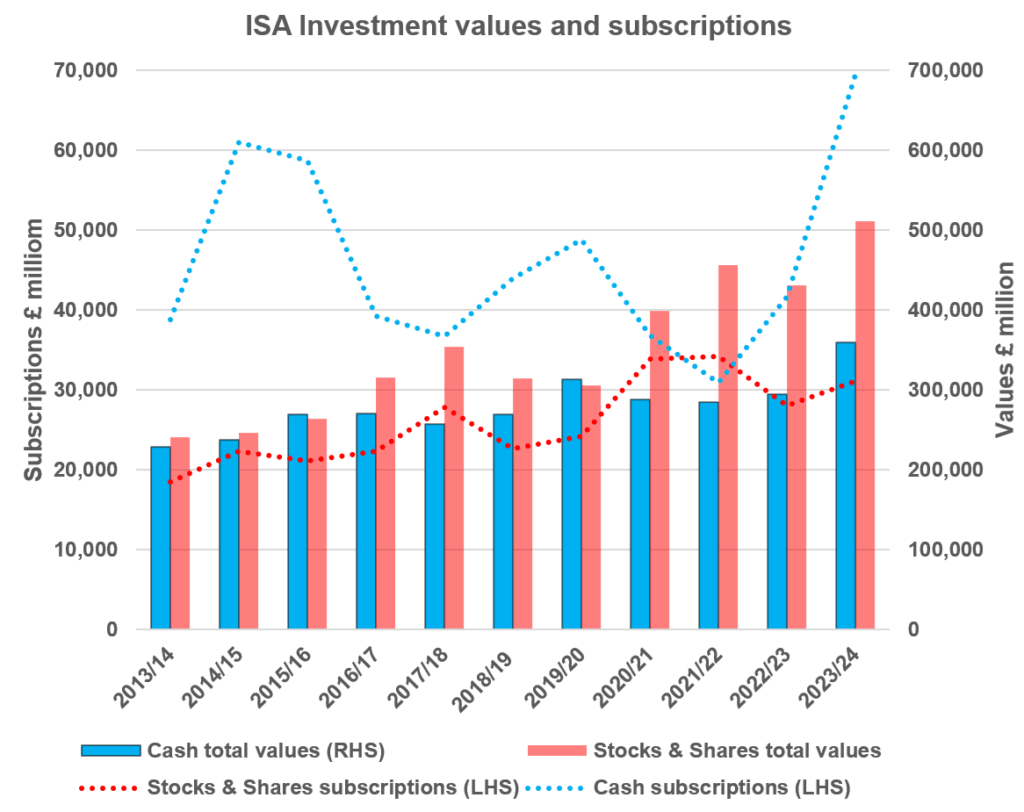
Statistics published by HMRC in September cast a new light on the ISA debate. The data show that in 2023/24, subscriptions to cash ISAs were £69.5 billion, while stocks and shares ISAs attracted just over £31 billion. That brought the total amount invested in cash ISAs to £360 billion as of April 2024. It would be reasonable to assume the total now is well above £400 billion.

Now put yourself in the Chancellor’s shoes. If the Bank of England had £400 billion earnings and 4% Bank Rate, it would mean £16 billion of interest on which no income tax is being collected. The latest estimate from HMRC is that the cost of income tax and capital gains tax relief for ISAs was £9.4 billion in 2024/25, almost a fifth up on the previous year. Cutting back on the amount flowing into cash ISAs could reduce tax loss, even though the prospect of enhanced returns is a better story to present to the public.

To be fair to the Chancellor, there is some justification in her argument. As HMRC’s ISA Investment values and subscriptions graph illustrates, to a degree, the total value of stocks and shares ISAs grew more rapidly than cash ISAs over the ten years to April 2024. However, cash ISAs saw little net inflow for much of the period. It is easy to forget now that the Bank of England rate was no more than 1% between February 2009 and June 2022, assuring miserable returns for money held on deposit.

Before you rush to arrange a pre-Budget cash ISA, it is worth reflecting on what you are trying to achieve. If you just want to move a ready money deposit to a tax shelter, remember that unless you are an additional/top rate taxpayer, the personal savings allowance (PSA) covers up to £200 of tax on interest (20% for basic rate x £1,000 PSA or 40% higher rate x £500 PSA).

If you are setting aside money for long-term growth, then, as the Chancellor suggests, there could be better options.

Government guidance on how ISAs work is here.