New first time buyer ISA on the cards

ISA

Although no date for its introduction has yet been announced, the government has recently provided some details for the new first time buyer individual savings account (FTB ISA), which is set to replace the lifetime ISA (LISA).

Essential differences

The LISA never garnered a large take-up, so its replacement has some fundamental changes:

  • Target: The FTB ISA is for first-time property purchasers only, whereas the LISA can also be used to save money for retirement.
  • Age limit: To open a LISA, a saver must be 18 to 40, with no subscriptions allowed over age 50. With the FTB ISA, the only requirement is that a saver be 18 or over; there is no upper age limit.
  • Bonus: With the LISA, the government bonus is paid monthly, so the saver benefits from interest or investment growth on bonus payments. However, with the FTB ISA, the bonus will only be paid when a property is purchased.
  • Withdrawal penalty: The LISA comes with a withdrawal penalty of 25%, meaning a saver will end up with less than they paid in. There will be no penalty for withdrawing funds from the FTB ISA.

The government has said that any change to the property price cap of £450,000 will apply to both products.

Interaction

A saver who already has a LISA, or opens one before the FTB ISA is introduced, will be able to continue to contribute to it indefinitely. Although it will not be possible to transfer a LISA into the FTB ISA, a saver will have the choice each tax year whether to save into a LISA or FTB ISA. It will then be possible to combine the funds held in both accounts when making a property purchase.

Although there is no withdrawal penalty for the FTB ISA, the timing of the government bonus would seem to give the LISA a distinct advantage, although full details of the new product have yet to be announced.

The government’s guide to lifetime ISAs can be found here.

The ‘mansion tax’ and property prices – what’s to come?

Mansion

Further details have emerged about the potential impact of the ‘mansion tax’ announced in the last Budget.

Rachel Reeves’ first two Budgets have so far featured announcements of tax-raising measures with delayed starting dates. For example, the controversial changes to inheritance tax (IHT) business and agricultural relief emerged in October 2024, but have only just taken effect. Similarly, bringing pensions within the scope of IHT was announced at the same time, but will not commence until 6 April 2027.

In her Autumn 2025 Budget, she set out plans for a High Value Council Tax Surcharge (HVCTS – aka ‘mansion tax’) on homes valued at £2 million and above, to start in April 2028. There was little detail about the measure, but a consultation was promised “in the New Year”. So far, nothing has been published by the Treasury, but just before Easter, the Office for Budget Responsibility (OBR) set out its assessment of the new tax’s impact. These included some interesting nuggets:

  • By 2028, the OBR thought the full value of the future HVCTS liability would be reflected in property prices. Although the OBR did not spell out the numbers, what this means in practice is that for every £1,000 of consumer price index (CPI)-linked HVCTS annual charge, the OBR expects a property’s value to drop by about £35,000. For the lowest £2,500 charge covering properties valued at £2–2.5 million, their value would drop by about £87,500, according to OBR theory.
  • The OBR forecasts that there will be a bunching of prices just below each threshold, which would further lower prices for properties that would otherwise be just above a threshold. The OBR is on solid ground with this assumption, as it is exactly what happened when a single stamp duty rate was based on a house’s price.

Property value in 2026

HVCTS in 2028/29

£2m to £2.5m

£2,500

£2.5m to £3.5m

£3,500

£3.5m to £5m

£5,000

£5m +

£7,500

  • One-in-five property owners (who are liable to the tax, rather than the occupiers) are expected to lodge an appeal, with a 40% success rate.

Perhaps the most telling point is that the new tax would initially raise only £400 million in 2028/29, hardly even a rounding error in Treasury accounting terms. Almost the same sum could have been generated by raising the standard rate of VAT from 20% to 20.04%, although the politics would have been much trickier.

We’ll have to wait and see if the OBR’s expectations pan out. Read more on HVCTS here.

House prices versus inflation

Houses

Bricks and mortar are not always a sure-fire winner.

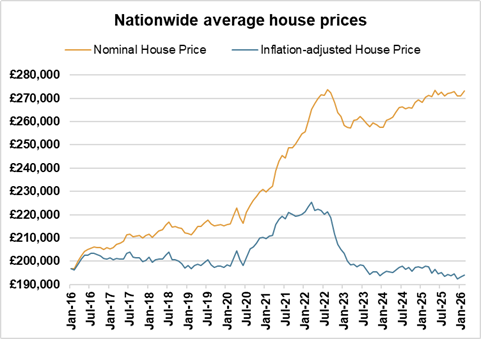
From January 2016 to January 2026, did house prices grow faster than inflation? The answer is in the graph below.

    Source: Nationwide, ONS

Nationwide Building Society says the average UK house price in January 2016 was £196,829. Ten years later, it had risen to £270,873, a 37.6% increase. Over the same period, the Consumer Prices Index (CPI) increased by 40.2%.

If the result is not what you expected, it could be because you remember the unexpected boom during and immediately after the Covid-19 pandemic, but forgot the somewhat turgid period for house prices that followed. In the three years from January 2023, the average house price rose by 4.9%, while the CPI added 10.4%.

Ironically, some of the recent slowdown in house price growth is linked to general inflation. One factor that put the brake on house prices was the increase in interest rates made by the Bank of England to bring down inflation (which peaked at over 11% in October 2022). Until June 2022, the Bank of England’s rate was no more than 1%. As anyone facing the imminent expiry of a five-year fixed rate mortgage knows, the Bank’s action on interest rates, now compounded by the war in Iran, has made borrowing considerably more expensive than half a decade ago.

The near-flatlining of house prices and, until recently, cuts to mortgage rates did make life marginally easier for first-time homebuyers. That has not been good news for one group of existing property owners: buy-to-let investors. Zoopla, the property website, reported that at the start of the year, average enquiries per rental property were at their lowest level since 2019 and down a fifth on January 2025. Reduced demand has translated into slowing rental growth, which has come down from 7.8% annual growth in January 2025 to 3.1% a year later, according to data from the Office for National Statistics (ONS). In England, buy-to-let investors are also facing the implementation of the Renters’ Rights Act, which from 1 May 2026 will put an end to no-fault evictions (‘section 21 orders’).

Buying and owning your own home generally remains a sensible move, but be wary of treating it as the only investment you need to make.

Read more on private rent and house prices from the ONS here.