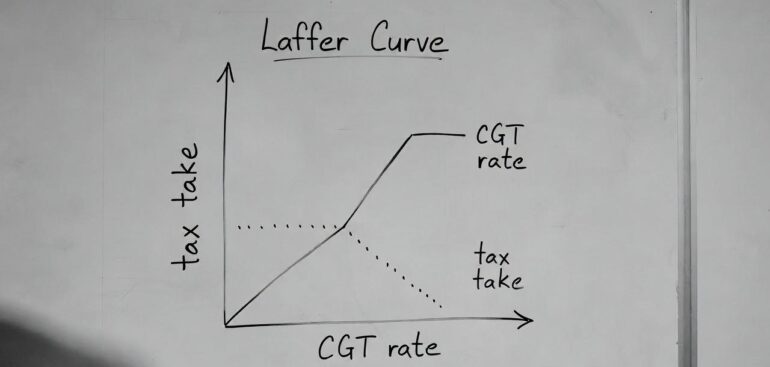
CGT hikes lead to reduced tax take

The government cut the capital gains tax (CGT) annual exempt amount from £12,300 in 2022/23 to just £3,000 from 2024/25 onwards. You might expect this to lead to a higher tax take, but the results so far have been the exact opposite.

Downward trend

In addition to the annual exempt amount reduction, the rates of CGT on gains from shares and securities (plus other non-residential property) were increased partway through 2024/25 from 10% and 20%, to 18% and 24%:

  • However, CGT receipts were £16.9 billion in 2022/23, falling to £14.5 billion for 2023/24, and to just £13.5 billion for 2024/25.
  • This indicates how sensitive CGT is to taxpayers’ behaviour, with many investors simply sitting on their gains and deferring disposals.

The latest CGT receipts show how increasing tax rates and reducing exemptions doesn’t necessarily mean a straight line to more revenue – a good example of the Laffer Curve in action.

The Laffer Curve

The Laffer Curve represents the theoretical relationship between tax rates and the resulting tax take. If tax rates are set too high, the tax take will start to reduce.

In some cases, it is difficult for taxpayers to do much to mitigate the impact of tax increases. The take from employer national insurance contributions (NICs), for example, has increased dramatically since the starting threshold was reduced and the rate increased. The latest figures for December 2025 show the tax take has increased by 25% compared to the previous December:

  • In contrast, many taxpayers whose income has reached £100,000 have decided that doing an extra £1,000 worth of work is not worthwhile if the resulting take-home pay is just £380.
  • With tax thresholds frozen since 2021/22, an estimated 1.8 million taxpayers now earn more than £100,000, with another 490,000 likely to be caught over the next four years.
  • Many are avoiding the 62% tax trap by reducing the hours they work, declining a promotion or negotiating a pay cut in return for additional holiday.

HMRC’s latest bulletin detailing tax receipts and NICs can be found here.

Can you beat the dividend tax rates rise?

From 6 April 2026, the basic and higher tax rates on dividend income are going to increase by two percentage points. This means owner-managers need to act as a matter of urgency if they wish to benefit from some fairly basic tax planning.

The basic and higher tax rates on dividend income are currently 8.75% and 33.75%, respectively, but these rates are going up to 10.75% and 35.75%. The dividend additional tax rate is not changing.

Current tax planning

It makes sense to bring forward a dividend to 2025/26 if this will save the two percentage points in tax, even though it will mean tax is payable a year earlier. For example, if a higher rate taxpayer brings forward a dividend of £25,000, this will save £500 in tax, although the liability will be due 31 January 2027 rather than 31 January 2028.

Future tax planning

Although extracting profits with a mix of a low salary and high dividends has often been the most beneficial approach, the balance is shifting towards taking higher salary:

  • Take, for example, Daniela, a higher rate taxpayer who is the sole director and shareholder of Dan Ltd. For the year ended 31 March 2027, Dan Ltd is expected to make profits of £150,000, of which Daniela wants to extract £100,000.
  • If Daniela takes a salary of £12,570 (to use her personal allowance) plus dividends of £87,430, the total personal tax, corporate tax and national insurance contributions (NICs) cost for her and Dan Ltd will be nearly £56,000.
  • However, if Daniela takes the whole £100,000 as salary, the overall tax and NIC cost will be about £3,000 less.

It should be noted, however, that Daniela’s net tax income is nearly £10,000 less with the salary option, because of the way the tax cost is distributed between her and Dan Ltd. If the figures are adjusted so that Daniela has roughly the same net income, there is then a modest tax advantage to taking a low salary and high dividends. However, there can be non-tax advantages to taking salary, such as making it easier to apply for a mortgage.

The best extraction strategy will vary from director to director depending on factors such as other income, whether the NIC employment allowance is available, pensions and company profits.

The government’s guidance on changes to the tax rates for property, savings and dividend income can be found here.

Growing confidence in managing tax digitally

More individuals are taking control of their tax affairs as the use of HMRC’s app surges. Some seven million taxpayers used the app in 2025, which is a 40% increase on the previous year.

Key areas

There are three key areas of the app which users are finding increasingly useful:

  • State Pension forecast: This service shows how much State Pension you could get, the exact date when you will be entitled to your pension, whether you can increase your entitlement, and how much the increase will be if contribution gaps are filled.
  • Child Benefit: You can apply for child benefit using the app, and thereafter view your payment history, update bank details, and let HMRC know if a child is staying in full-time education past the age of 16. If liable for the high income child benefit charge, the app can be used to arrange for the charge to be collected through your PAYE tax code.
  • National Insurance (NI): The app can store your NI number in a digital wallet, so it is conveniently available when needed. This feature is particularly useful for employees, because obtaining a confirmation letter from HMRC can take at least two weeks.

A helpful new feature allows a taxpayer to tell HMRC that they no longer need to submit a self assessment tax return.

Set up

The HMRC app can be downloaded from either the App Store (Apple devices) or the Google Play Store (Android devices). It is then just a matter of using your Government Gateway user ID and password to sign in for the first time. Thereafter, the app can be accessed with a 6-digit PIN, fingerprint or facial recognition.

The HMRC app currently seems to work much better on Apple devices (4.8 rating) than on Android devices (3.9 rating). Many Android users are encountering access issues.

The HMRC app can be found here and here.