
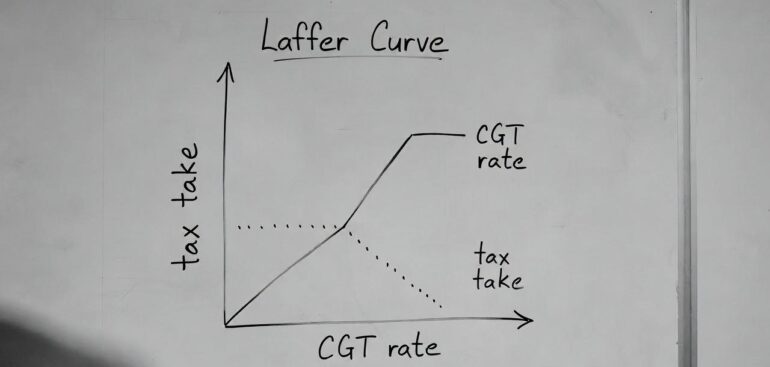
CGT hikes lead to reduced tax take

The government cut the capital gains tax (CGT) annual exempt amount from £12,300 in 2022/23 to just £3,000 from 2024/25 onwards. You might expect this to lead to a higher tax take, but the results so far have been the exact opposite.

Downward trend

In addition to the annual exempt amount reduction, the rates of CGT on gains from shares and securities (plus other non-residential property) were increased partway through 2024/25 from 10% and 20%, to 18% and 24%:

  • However, CGT receipts were £16.9 billion in 2022/23, falling to £14.5 billion for 2023/24, and to just £13.5 billion for 2024/25.
  • This indicates how sensitive CGT is to taxpayers’ behaviour, with many investors simply sitting on their gains and deferring disposals.

The latest CGT receipts show how increasing tax rates and reducing exemptions doesn’t necessarily mean a straight line to more revenue – a good example of the Laffer Curve in action.

The Laffer Curve

The Laffer Curve represents the theoretical relationship between tax rates and the resulting tax take. If tax rates are set too high, the tax take will start to reduce.

In some cases, it is difficult for taxpayers to do much to mitigate the impact of tax increases. The take from employer national insurance contributions (NICs), for example, has increased dramatically since the starting threshold was reduced and the rate increased. The latest figures for December 2025 show the tax take has increased by 25% compared to the previous December:

  • In contrast, many taxpayers whose income has reached £100,000 have decided that doing an extra £1,000 worth of work is not worthwhile if the resulting take-home pay is just £380.
  • With tax thresholds frozen since 2021/22, an estimated 1.8 million taxpayers now earn more than £100,000, with another 490,000 likely to be caught over the next four years.
  • Many are avoiding the 62% tax trap by reducing the hours they work, declining a promotion or negotiating a pay cut in return for additional holiday.

HMRC’s latest bulletin detailing tax receipts and NICs can be found here.

What might spark a CGT bill?

With basic rate taxpayers now facing doubling capital gains tax (CGT) rates, and with the exempt amount a quarter of its previous level, it is no surprise that considerably more CGT is being paid to HMRC.

Given the changes taking place, it is important to understand the rules.

Rates of CGT

Basic rate taxpayers now pay CGT at the rate of 18%, with a 24% rate for higher rate taxpayers. Rates were previously 10% and 20% respectively, so this is an unpleasant tax hike for couples who arrange for their taxable gains to be made by the lower income partner.

Disposals

A common misconception is that CGT is only due if an asset is sold, but assets given away to anyone other than a spouse or civil partner are also disposals. Furthermore:

  • With no proceeds coming in if a gift is made, there might be no funds available to pay the related CGT bill.
  • Selling an asset, such as a second property, to a son or daughter at an undervaluation doesn’t avoid CGT. The tax calculation will be based on the asset’s market value.

Similarly, an exchange of assets does not avoid CGT. Again, the market value of each asset will be used when calculating each person’s CGT liability.

When it comes to cryptocurrency, there can be a gain if it is used to pay for goods or services, or if there is a switch in currencies – such as converting Bitcoin into Ethereum.

Some basic planning

Although there is now less scope for CGT planning, there are still opportunities:

  • Make use of your £3,000 exempt amount each tax year, as it cannot be carried forward;
  • Making personal pension contributions in the same year as a disposal may reduce the rate of CGT from 24% to 18%; and
  • Crystalise assets standing at a loss so that the losses can be used to reduce taxable gains (but be careful not to waste the exempt amount).

Spouses and civil partners should plan as a couple, so that two exempt amounts and basic rate bands can be utilised.

HMRC’s guide to CGT (when it is paid, on what, rates and allowances) can be found here.