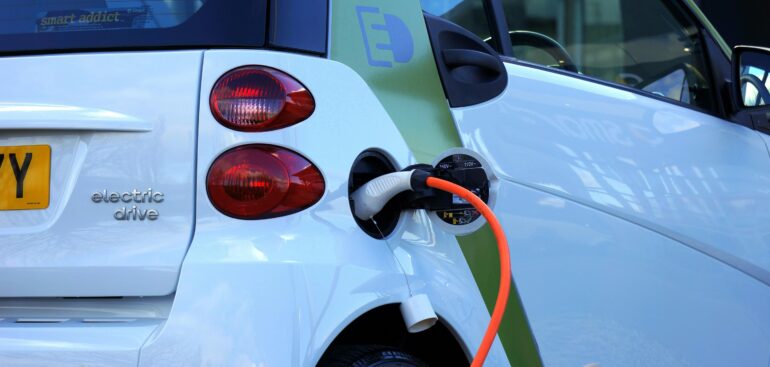
Electric car charging rates change – home and away

Mileage

Starting 1 September 2025, two separate advisory fuel rates apply to fully electric cars depending on whether charging is at home or using a public charger.

HMRC’s advisory fuel rates can be used to reimburse employees for business travel in their company cars, or where employees are required to repay the cost of fuel used for private travel.

Rates

The electric car rate was previously 7p per mile, regardless of where charging took place. Reimbursement at this rate meant company car drivers could be faced with a substantial shortfall if they made extensive use of public charging networks.

Advisory rates are now 8p for home charging, with 12p for public charging. Although the previous single rate can continue to be used until 30 September, from 1 October only the new rates can be applied. This means:

  • The change to two separate rates reflects the higher cost of using public charging locations.
  • However, the public charging rate is based on the typical cost of a slow or fast charge. It will, therefore, normally be less than what a driver would pay to use an ultra-fast charger.
  • If this is the case, reimbursement can reflect the higher, actual, cost provided the rate can be substantiated.

As long as business mileage is reimbursed at an acceptable rate – the advisory rate or a substantiated higher rate – employees will not face a taxable fuel benefit, and there are no national insurance contribution implications for either the employer or employees.

In addition, having rates for different charging locations means more complicated record-keeping requirements for employers.

Hybrids

The change only impacts on fully electric cars. Hybrids are treated as either petrol or diesel cars, so the advisory rates for these types are relevant. There are no changes to the petrol rate from 1 September, but two of the diesel rates have increased by 1p per mile.

HMRC guidance on its advisory fuel rates can be found here.

Selling your company business

An important consideration when selling your business is whether business asset disposal relief (BADR) will be available to minimise the capital gains tax (CGT) cost. BADR will be less advantageous from April 2026, so company owners may be looking to sell sooner rather than later.

BADR is currently at a flat rate of 14%, which is 10% lower than the higher rate of CGT. The rate will go up to 18% from 6 April 2026.

Calculating the gain

In many cases, the gain will just be the difference between the selling price and the nominal value of the shares sold. However, establishing the base cost will be more problematic if shares were inherited or received as a gift. Any further amounts invested in the business as share capital will also increase the base cost.

Capital gains tax

There are various conditions attached to BADR, which are basically:

  • The company has to be a trading company;
  • A 5% shareholding test must be met; and
  • You must be a director (or employee) of the company being sold.

These conditions have to be met for a minimum of two years before the sale, so it may be worth postponing a sale where the two-year ownership condition is not met.

BADR has a lifetime limit of £1 million of qualifying gains. This will not be an issue for many company owners, but it might be a problem if relief has been claimed previously.

Other considerations

While it will suit most company owners to sell their shareholding in return for cash, the buyer might prefer to purchase the assets of the company instead; this complicates the tax situation.

Furthermore, rather than a straight cash sale, the buyer will often want the seller to accept shares or loan notes as part of the consideration. Such an arrangement will keep the outgoing owner involved once the business has been sold. To the same end, the buyer may propose a phased payment plan, with an initial amount upfront, followed by further payments linked to future business performance.

Professional advice is essential when selling a business, so please contact us well in advance of any planned disposal.

HMRC’s guide to BADR can be found here.

Miscalculated corporation tax reliefs targeted by HMRC

Companies that may have miscalculated their corporation tax marginal relief may receive a letter from HMRC as part of a new campaign. The targeted errors could be due to ignoring associated companies.

Associated companies

Directors will be aware that the first £50,000 of their company’s profit benefits from a corporation tax rate of 19%, compared to the main rate of 25% applicable once profits hit £250,000. This means:

  • Marginal relief eases the transition from the 19% rate to the main rate.
  • Directors may not appreciate, however, that the £50,000 and £250,000 limits are shared across associated companies.
  • For example, if a company has two associated companies, marginal relief will apply on profits between £16,667 and £83,333.

Essentially, companies are associated if one is under the control of the other, or if both are under common control. It doesn’t matter whether a company is associated for part of an accounting period, or where a company is resident. However, dormant companies are not treated as associated.

The associated company rules can be quite complex, and, in some circumstances, a company owned by a spouse, civil partner, parent, child or sibling can be treated as an associated company.

One-to-many letters

Any company receiving a letter only has 30 days in which to respond to HMRC, and, if necessary, make any amendment. HMRC could, of course, be mistaken, such as where an alleged associated company is, in fact, dormant.

What a director should definitely not do is ignore a letter. If HMRC were to follow up with a formal compliance check, the process would likely be time-consuming and costly.

Planning

If a company’s corporation tax is higher than it would otherwise be as a result of having associated companies, the overall company structure needs to be reviewed. For example, two companies under common control might have profits of £49,000 and £1,000 respectively. The total corporation tax bill could be reduced by £1,800 if the two companies were combined into one company.

HMRC’s guidance on marginal relief can be found here.