What goes into the tax cocktail?

tax cocktail

New data from HMRC shows how much the government relies on just four taxes.

Source: HMRC

The Labour Party went into the 2024 general election with pledges on four major taxes in its manifesto:

  • “Labour will not increase taxes on working people, which is why we will not increase National Insurance, the basic, higher, or additional rates of Income Tax, or VAT.”
  • “Labour will cap corporation tax at the current level of 25 per cent, the lowest in the G7, for the entire parliament…”

At the time, the tax promises were seen as politically necessary to counter suggestions that a Keir Starmer government would operate tax-and-spend policies. However, the quadruple tax lock was widely criticised by many economists for the half decade constraint that it placed on the Chancellor in uncertain times.

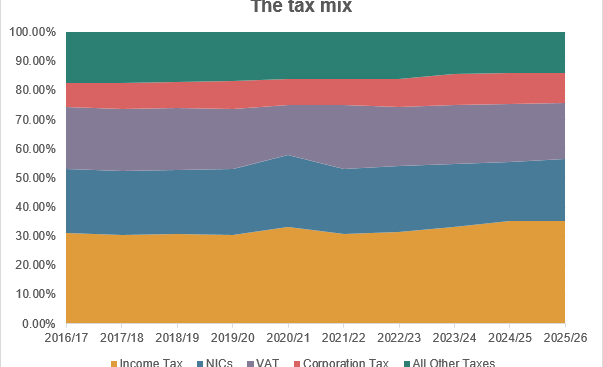
Fast forward about two years from the publication of that manifesto, and the economists have been vindicated. New data from HMRC, published at the end of April, showed that in the past tax year, income tax, national insurance (NI), VAT and corporation tax accounted for 86% of all tax receipts. That is not surprising – as the graph shows, over the past ten years, the quartet account for more than £4 out of every £5 tax collected.

Despite the manifesto promise, income tax receipts rose by 9% in 2025/26 from the previous year – faster than the growth in prices or the UK economy. That outpacing is due to the freezing of the personal allowance and tax thresholds, dragging more people into tax and more existing taxpayers into higher tax bands.

NI receipts grew even faster – 16.3% up – thanks to the manifesto-challenging changes to the level of employer’s NI contributions. Together, NI and income tax – the two taxes on earnings – accounted for 56.5% of all that flowed into HMRC’s coffers.

The jumps in taxes on earnings contrasted with the growth in the third largest source of tax, VAT, which grew by 5.7%. Corporation tax had even slower growth (4.6%), but that might be because employers claimed more tax relief on those higher NI contributions.

The dominance of the big four manifesto-locked taxes explains why the Chancellor has made so many tweaks to the overall system to raise additional revenue. Be prepared: it is beginning to look like that process will be repeated at the next Budget.

For HMRC’s latest bulletin on tax receipts and NI contributions, visit here.

Soaring tax receipts for CGT and NICs

The amount of tax collected by HMRC for 2025/26 increased by 9.3% compared to the previous year. The figure is unsurprising given the hike in capital gains tax (CGT) rates, as well as employer national insurance contributions (NICs).

Receipts for CGT

CGT receipts for 2025/26 were an astonishing 62% higher than for 2024/25:

CGT is sometimes described as an ‘optional tax’, as it can be avoided by postponing disposals. There is also no CGT charge on death, and future governments may choose to reduce CGT rates.

  • However, those who did sell assets faced a hike in rates from 10% and 20% to 18% and 24%. Many landlords will have sold up in advance of the Renters’ Rights Act 2025 coming into force, while business owners could have benefited from a tax rate saving of 4% by selling prior to 6 April 2026.

There is little to be done during one’s lifetime to escape CGT on buy-to-let properties, but those with a substantial investment portfolio might want to postpone disposals to later in life, if they are planning to retire abroad. With careful planning – professional advice being essential here – CGT can be mitigated; the tax saved might mean a better standard of living in retirement is affordable.

Employer NICs

The receipts from Class 1 employer NICs have gone up to nearly £144 billion, an increase of over £35 billion.

There is limited scope for most employers to avoid the increases, which came in from April 2025, although an unincorporated business might consider taking on senior staff as partners, though probably as limited partners to prevent any personal liability should the business fail.

Be warned that there has been some speculation regarding the introduction of some type of employer NICs on partnership profits.

Receipts on income tax

Income tax receipts have risen less sharply, although frozen thresholds and allowances are inexorably taking their toll, dragging more and more taxpayers into higher tax bands. Some higher earners may contemplate relocating to a more tax-friendly jurisdiction, which, if the overseas stay is long enough, could avoid CGT on the disposal of investments.

Details of HMRC tax receipts and NICs can be found at HMRC official statistics.

House prices versus inflation

Houses

Bricks and mortar are not always a sure-fire winner.

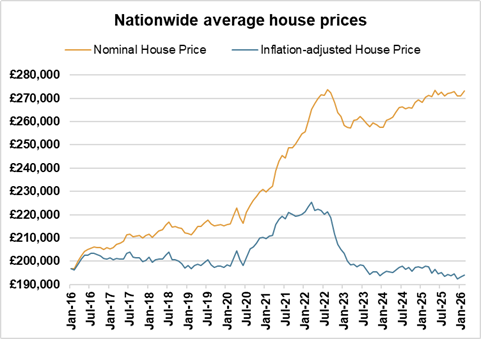
From January 2016 to January 2026, did house prices grow faster than inflation? The answer is in the graph below.

    Source: Nationwide, ONS

Nationwide Building Society says the average UK house price in January 2016 was £196,829. Ten years later, it had risen to £270,873, a 37.6% increase. Over the same period, the Consumer Prices Index (CPI) increased by 40.2%.

If the result is not what you expected, it could be because you remember the unexpected boom during and immediately after the Covid-19 pandemic, but forgot the somewhat turgid period for house prices that followed. In the three years from January 2023, the average house price rose by 4.9%, while the CPI added 10.4%.

Ironically, some of the recent slowdown in house price growth is linked to general inflation. One factor that put the brake on house prices was the increase in interest rates made by the Bank of England to bring down inflation (which peaked at over 11% in October 2022). Until June 2022, the Bank of England’s rate was no more than 1%. As anyone facing the imminent expiry of a five-year fixed rate mortgage knows, the Bank’s action on interest rates, now compounded by the war in Iran, has made borrowing considerably more expensive than half a decade ago.

The near-flatlining of house prices and, until recently, cuts to mortgage rates did make life marginally easier for first-time homebuyers. That has not been good news for one group of existing property owners: buy-to-let investors. Zoopla, the property website, reported that at the start of the year, average enquiries per rental property were at their lowest level since 2019 and down a fifth on January 2025. Reduced demand has translated into slowing rental growth, which has come down from 7.8% annual growth in January 2025 to 3.1% a year later, according to data from the Office for National Statistics (ONS). In England, buy-to-let investors are also facing the implementation of the Renters’ Rights Act, which from 1 May 2026 will put an end to no-fault evictions (‘section 21 orders’).

Buying and owning your own home generally remains a sensible move, but be wary of treating it as the only investment you need to make.

Read more on private rent and house prices from the ONS here.