

The other gender pay gap

The gender pay gap does not disappear when work ends. If anything, it gets worse.
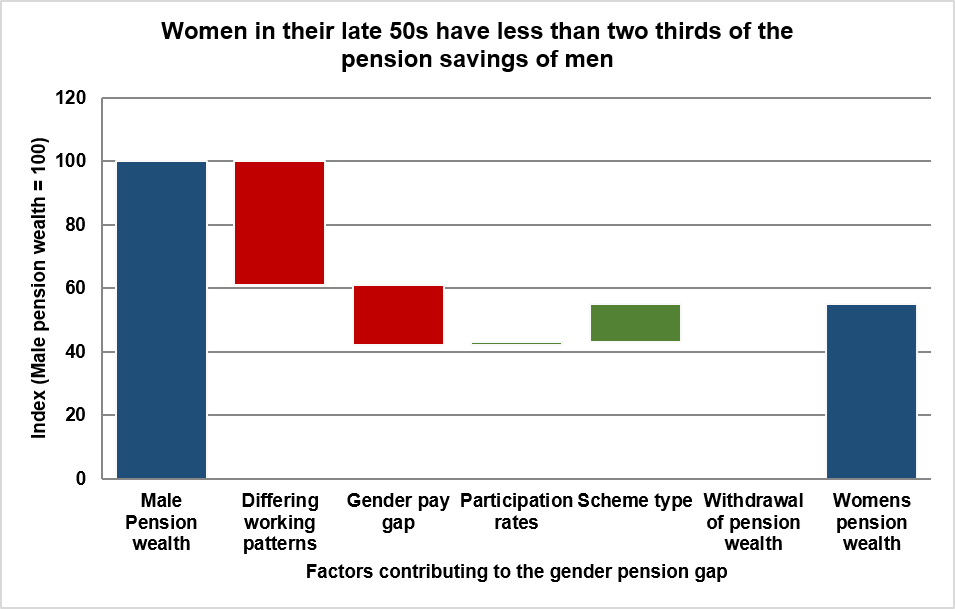
Source: PPI

How wide is the gender pay gap? The answer might surprise you. The most recent assessment from the Office for National Statistics (ONS) puts the gap for full-time employees in April 2025 at 6.9%. In 2005, the ONS figure was nearly twice as much – 13%.

However, there is another gender pay gap where the difference between the sexes is far greater – the gender pension gap. A new report from the Pension Policy Institute (PPI) has highlighted the gap – chasm might be a better description – in pension wealth between men and women in their late 50s, typically within ten years of retirement.

The graph above is based on men and women aged 57 and shows a gap of 46%. Viewed from the male perspective, this means on average a 57-year-old man has 85% more in his pension pot than a woman of the same age. The PPI attributes the yawning gap to a variety of factors, with the two main ones being:

  • Differing working patterns: The proportion of women in employment is lower than for men (75% vs 82%). Among those who are in employment, more women tend to work part-time (33% vs 10%), often because they are a family’s primary caregiver. The gender pay gap for part-time work favours women – the ONS says women part-timers earn 2.9% more than their male counterparts. The snag is that while the pay rate may be higher, total earnings are lower than for full-time work.
  • Gender pay gap: Pension contributions are normally linked to pay – contributions are often a percentage of salary. As women on the whole earn less than men, the same percentage contribution produces a smaller cash contribution and so a smaller pension pot. At low earnings levels, this can be exacerbated by the automatic enrolment rules, which exclude anyone earning up to £10,000 a year and, for those who are enrolled, ignore the first £6,240 of earnings in calculating contributions. That equates to about £500 a year of contributions (at 8%) that are not made.


If you find yourself on the wrong side of the pension gender gap, consider increasing your personal pension contributions if possible. And take advice on your overall retirement planning. Read more about the gender pay gap here.

Pension triple lock reform breaks out

Pensions

The state pension triple lock is set to be adjusted under new proposals.

The triple lock was introduced by the coalition government in 2010 with the goal of raising the value of the basic state pension as a proportion of average earnings. It currently requires the old and new state pension (but not any other state pension components) to increase each April by the greater of:

  • Yearly consumer price index (CPI) inflation to the previous September;
  • The annual growth in average earnings (including bonuses) for the previous May to July period; or
  • 5%.

At the time of writing, it looks almost certain that for April 2027, the triple lock increase will be determined by the earnings growth number, which was 3.9%. August 2026 yearly inflation was 3.1%.

What might change?

In his late September speech to the Labour Party conference, Andy Burnham proposed to “adjust” the triple lock so that from 2030 onwards – after the next election – increases would be the greater of:

  • CPI inflation;
  • 5%; and
  • the amount required to ensure the state pension grows in line with average earnings growth from 2030.

The difference from the current version may sound like the proverbial splitting of hairs, but it will have long-term impact. The present best-of-three system has a ratcheting effect, which means that in the long run the state pension rises faster than earnings. This would not be the case for Burnham’s adjusted triple lock.

According to the Resolution Foundation, if the new mechanism had been in place since 2012, it would have meant the State Pension was:

  • 5% higher than if increases were linked to earnings, but
  • 9% lower than the existing triple lock.

The impact would then probably come through only slowly. From 2030 there will be no effective change from the current version of the triple lock, while yearly earnings growth outpaces both price inflation and 2.5%. Nevertheless, in the long term, the savings on pension expenditure could be significant. The government estimates that by the end of the 2030s, savings could amount to £15 billion a year, rising to £50 billion a year by 2050.

Those savings are earmarked for funding adult social care, but they also mean a less generous state pension than the current triple lock would provide. A reminder that personal pension planning is a key component of future financial well-being.

Read more about the prime minister’s plans for a new national care service here.

Pension scams warning

Pensions

Anyone confused or anxious about the inheritance tax (IHT) changes being introduced for pensions needs to be aware that scammers might try to target their savings.

Changes to pensions

From 6 April 2027, inherited pension funds will be subject to IHT unless inherited by a spouse or civil partner. Not surprisingly, scammers are using the change as an opportunity to target your pension savings. The scam works by offering a ‘safe haven’ overseas for your pension savings. Two problems here: one is quite important, but the second is more serious:

  • First problem: For anyone who is a long-term resident in the UK, moving a pension fund overseas will not affect the IHT position because worldwide assets – including overseas pension funds – are included as chargeable assets for UK IHT purposes.
  • Major problem: Whether the tax planning works or not is irrelevant as the fraudster will simply plunder your pension fund.

The scams you need to know

Pension scams are becoming increasingly sophisticated, with scammers using artificial intelligence (AI) and deepfake technology to make the scam appear more convincing. There are several red flags to watch out for:

  • The first warning should be if the initial email, call or message comes unexpectedly. Cold calling about pensions is illegal, so you should treat any unsolicited approach with suspicion.
  • Along with the ‘IHT saving’, the scammer will tempt you with the higher returns available if funds are moved.
  • The scammer will want to apply pressure by saying you only have a limited amount of time to accept their offer.

A scammer wants their victim to act impulsively and alone; they definitely don’t want them to obtain professional advice.

Should you agree to transfer your funds, the scammer will often provide coaching on how to circumvent your pension provider’s safety rules: for example, by providing an answer as to why funds are being moved.

The old adage of ‘it sounds too good to be true’ is invariably true in these cases, so any approach should be treated with extra caution.

The Financial Conduct Authority’s online tool to check whether a company is authorised or not is available here.