Companies House tightens fees

maintain certain registers, the downside is a substantial increase to the fees charged. The doubling cost of incorporating a business is a particular sting in the tail.

Changes to registers

There is no longer a requirement for companies to hold registers of directors, directors’ usual residential addresses, secretaries and persons with significant control (PSCs). However, this information must still be provided to Companies House and kept up to date. The latest changes are, to be clear:

  • Companies are still required to maintain a register of members, both past and present, including the date when each person became a member, and, where relevant, the date when membership ceased.
  • Normally, the register will contain information on shareholders but will show guarantors if a company is limited by guarantee.
  • Companies can no longer elect to use the central register at Companies House and must now keep their own register of members.

Changes to fees

Many of the fees charged by Companies House will increase from 1 February 2026:                                                                                                                                          


  • Company formation: Currently, the cost of digitally registering a company or a Limited Liability Partnership with Companies House costs £50, but this will double to £100. The cost of same-day registration will also double to £156.
  • Confirmation statements: Every company, including dormant ones, must file a confirmation statement at least once a year. The cost is currently £34, and this is going up to £50.

Despite the general fee increases, the cost of voluntarily striking off a company will be reduced by 60% to just £13.

Many people setting up a new company will do so via a company formation agent. Their most basic offerings only add a small margin to the Companies House charge, so the fees charged by agents are going to see similar increases.

A full list of the new fees charged by Companies House can be found here.

The Autumn 2025 Budget – a balancing act?

This year’s Budget risked becoming the winter budget, arriving as late as possible on 26 November after a long, rumour-filled run in.

The Chancellor’s first Budget last autumn, on 30 October 2024, came following the early announcements of a raft of revenue-saving measures to fill her infamous “£22 billion blackhole”. Rachel Reeves’s second Budget moved four weeks nearer to Christmas and was preceded by two significant summer U-turns – on the winter fuel payment and disability benefit reform – that implied about £6 billion of revenue-raising would be required.

The long lead time to the Budget this year meant almost three months of speculation after summer’s end. Thankfully, the Treasury’s constant drip of leaked policy ideas and subsequently generated media rumours finally ended, leaving the Budget as something of a 70-minute anti-climax.

The main measures of the Autumn Budget 2025 included:

  • A three-year extension to the freeze on income tax bands and the personal allowances. The Institute for Fiscal Studies (IFS) had earlier calculated that a two-year freeze would mean that by 2029/30, nearly one-in-four taxpayers would face a marginal tax rate of 40% or more.
  • A £2,000 cap from 2029/30 on the amount of salary that can be tax-efficiently sacrificed for pension contributions. Any excess will be liable to national insurance contributions for both employer (at 15%) and employee (at up to 8%).
  • A reduction to £12,000 in the maximum subscription to a cash Individual Savings Account (ISA) from 6 April 2027 for anyone aged under 65. The overall subscription limits for an adult ISA (£20,000) and a Junior ISA (£9,000) are unchanged. The Lifetime ISA stays at £4,000, while the government consults on a new first-time buyer’s ISA as its replacement.
  • The abolition of the two-child limit for universal credit and child tax credit, set to reduce child poverty by around 450,000 children in 2029/30.
  • A two percentage point increase in the rate of tax on dividends for basic rate and higher rate taxpayers to 10.75% and to 35.75%, respectively, effective from
    6 April 2026. The dividend tax rate is unchanged at 39.35% for additional rate taxpayers.
  • A two percentage point increase across all tax bands from 2027/28 for property and savings income.
  • The introduction of a three-pence per mile road charge for electric vehicles from April 2028.

The outcome was a Budget that did not deliver a headline punch but opted to tread a path between spending requirements and funding those requirements through additional borrowing and increased tax pressures.

For more information on any of these changes and how they could affect you, please contact us. The Autumn Budget 2025 can be read here

Cash ISAs twice as popular as stocks and shares ISAs

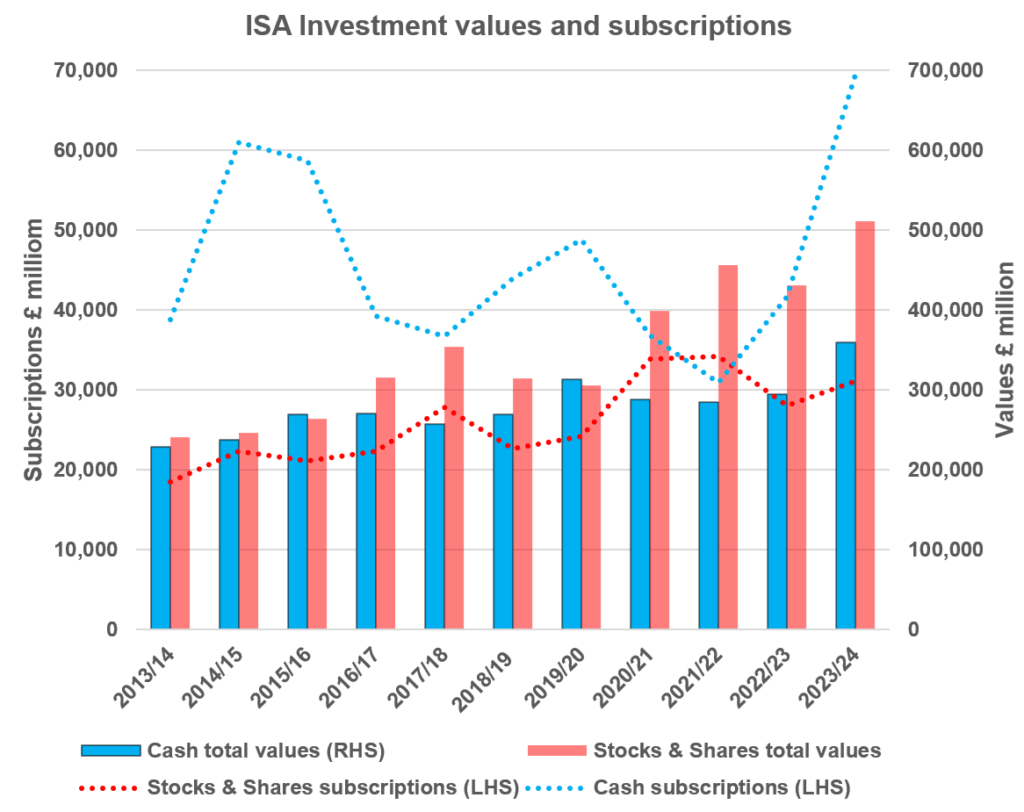
HMRC figures for 2023/24 show cash ISA subscriptions have increased by almost 224% more than stocks and shares ISAs by the end of the decade.

Source: HMRC.

The Chancellor’s plan to reform individual savings accounts (ISAs) to “improve returns for savers” has been considered for some time. Rachel Reeves’s scheme is widely believed to mean the current £ 20,000-a-tax-year subscription limit for ISAs would be reduced for cash ISAs. Unsurprisingly, the investment management industry has been in favour of such a move, while the big banks and the Building Societies Association have been strongly against it.

Statistics published by HMRC in September cast a new light on the ISA debate. The data show that in 2023/24, subscriptions to cash ISAs were £69.5 billion, while stocks and shares ISAs attracted just over £31 billion. That brought the total amount invested in cash ISAs to £360 billion as of April 2024. It would be reasonable to assume the total now is well above £400 billion.

Now put yourself in the Chancellor’s shoes. If the Bank of England had £400 billion earnings and 4% Bank Rate, it would mean £16 billion of interest on which no income tax is being collected. The latest estimate from HMRC is that the cost of income tax and capital gains tax relief for ISAs was £9.4 billion in 2024/25, almost a fifth up on the previous year. Cutting back on the amount flowing into cash ISAs could reduce tax loss, even though the prospect of enhanced returns is a better story to present to the public.

To be fair to the Chancellor, there is some justification in her argument. As HMRC’s ISA Investment values and subscriptions graph illustrates, to a degree, the total value of stocks and shares ISAs grew more rapidly than cash ISAs over the ten years to April 2024. However, cash ISAs saw little net inflow for much of the period. It is easy to forget now that the Bank of England rate was no more than 1% between February 2009 and June 2022, assuring miserable returns for money held on deposit.

Before you rush to arrange a pre-Budget cash ISA, it is worth reflecting on what you are trying to achieve. If you just want to move a ready money deposit to a tax shelter, remember that unless you are an additional/top rate taxpayer, the personal savings allowance (PSA) covers up to £200 of tax on interest (20% for basic rate x £1,000 PSA or 40% higher rate x £500 PSA).

If you are setting aside money for long-term growth, then, as the Chancellor suggests, there could be better options.

Government guidance on how ISAs work is here.