Maxing Tax Digital delayed until 2024

In recognition of the challenges to many businesses due to the pandemic, the government has delayed the introduction of Making Tax Digital (MTD) for income tax self-assessment (ITSA) by a further year.

MTD will not be mandatory for self-employed individuals and landlords until accounting periods commencing on or after 6 April 2024. The start date for general partnerships (those with only individuals as partners) will now be from April 2025, with the date for other types of partnerships still to be confirmed. The planned April 2026 commencement date for MTD for corporation tax now also seems uncertain.

Knock-on effect

The one-year delay means that:

  • The reform of the basis period rules for unincorporated businesses has been pushed back until at least April 2024, with the transition year no earlier than 2023 – so yet another change that now appears less certain than previously.
  • The new penalties for late payments and late submissions will now no longer apply to the self-employed and landlords (mandated to use MTD for ITSA) until April 2024, with other ITSA taxpayers included a year later.

No change

Although the delay will be welcomed by the majority of businesses, a delay is all it is. There is no change to the entry point (taxable turnover from self-employment and/or income from property over £10,000), nor to the requirement to keep digital records and provide quarterly returns using third-party software to HMRC.

HMRC has estimated the average transitional cost of becoming digital as £330, with an annual cost of £35 per business, although that assumes no new hardware will be required.

The delay will mean that more software packages are available before MTD for ITSA comes in, and there will be more opportunity to join the pilot scheme. If you are self-employed or a landlord, you should make the most of the extra time to ensure your business is ready come April 2024.

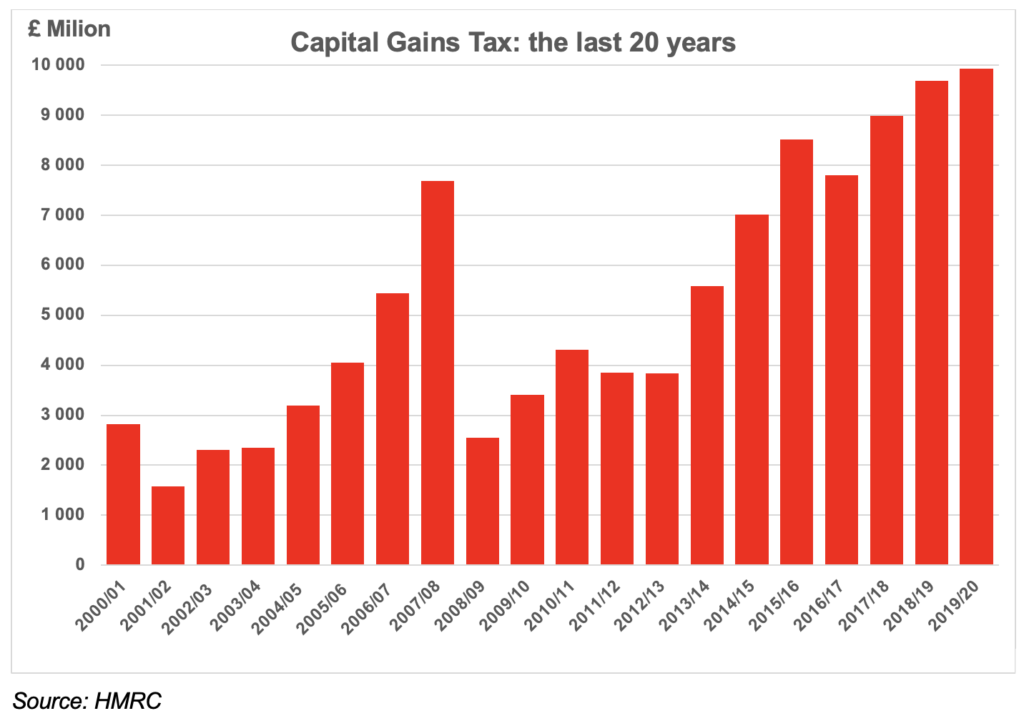
Capital gains tax receipts underline tempting target for Chancellor

New HMRC data shows that in 2019/20, £9.9 billion of capital gains tax (CGT) liabilities were created.

In July last year, the Chancellor unexpectedly asked the Office of Tax Simplification (OTS) to review “capital gains tax (CGT) and aspects of the taxation of chargeable gains in relation to individuals and smaller businesses”. The top tax rate currently sits at 28% (limited to residential property and carried interest) with 20% liability for other assets.

At the time, there was speculation that Rishi Sunak was looking at CGT as a way of raising extra revenue without breaking the Conservatives’ 2019 manifesto pledge not to increase rates for income tax, VAT and national insurance. With those receipts of nearly £10 billion, it’s certainly a tempting target.

The OTS produced its first report on simplifying the design of the tax last November, prompting the rumour mill to forecast that CGT changes would appear in the spring Budget. However, CGT barely received a mention in March beyond the freezing of the annual exemption for five tax years at the 2020/21 level of £12,300. In May 2021, the OTS issued a second report examining “practical, technical and administrative issues” of making changes to CGT.

The focus for CGT announcements is now on the next Budget. In theory, it is due in autumn, but in practice, it could once again be delayed until spring. By then, the economic landscape should be clearer as pandemic support measures cease and we will have weathered another winter of Covid-19.

New data released by HMRC in August shows why the Chancellor may be tempted to follow the OTS advice to:

  • Reduce the annual exemption to “a true de minimis level … in the range between £2,000 and £4,000”; and
  • More closely align CGT rates with income tax rates. The OTS reckons this could theoretically raise an extra £14 billion, although it accepted “behavioural effects” would significantly reduce this figure in practice.

If you have unrealised capital gains, it could be wise to review them before the next Budget.

New VAT penalties regime on the horizon

The existing penalty regime for VAT returns has the advantage of simplicity, but it’s something of a blunt instrument. The new system coming in for return periods beginning on or after 1 April 2022 will be fairer, but some businesses will find themselves caught up in a complex web of escalating penalties.

The penalty scheme will be clearly divided, with one regime for late payments and another for late VAT return submissions.

Late payments

Unlike the current system of default surcharges, each late payment will be considered separately, with the following penalties charged unless there is reasonable excuse:

Days late

Penalty

Up to 15

None

16 to 30

2% of outstanding VAT

More than 30

A further 2% penalty plus a daily penalty at a rate of 4% p.a. on the outstanding VAT


A business can avoid any further penalties accruing by entering into a time to pay arrangement with HMRC. For example, penalties are avoided if a business approaches HMRC when payments are already 12 days late.

For the first year, HMRC will take a light-touch approach to the initial 2% late payment penalty.

Regardless of whether any late payment penalties are charged, interest will be incurred from the due date until payment is made. A time to pay arrangement will not stop interest accruing.

Late submissions

Under a points-based system, a business will incur a penalty point for each late VAT return Businesses that file quarterly will be charged a £200 penalty when they reach a penalty threshold of four points.

  • Subsequent late VAT returns will also incur a £200 penalty.
  • Points expire after two years, but not once the penalty threshold is reached.
  • Once the penalty threshold is reached, a business filing quarterly will have to submit returns on time for twelve months for their points total to be reset to zero.

More detail is available on both late penalties and interest and late submissions from HMRC.