Confused on Claiming Residence Band Relief?

Working through inheritance tax (IHT) requirements come at a difficult time. The provisions of the residence nil rate band (RNRB), which can be passed on between deceased spouses and civil partners, has caused some confusion.

Any unused RNRB from the first death of a spouse or partner can be relieved on the death of the second individual. The claim is based on the value of the RNRB at second death, but some executors are mistakenly using the value at the date of first death.

The RNRB was introduced from 6 April 2017 at £100,000, increasing by £25,000 a year until reaching its current value of £175,000.

The claim for RNRB is made on IHT form IHT436, with the confusion coming from the entry at box 11: the value of the RNRB enhancement at the spouse or civil partner’s date of death. However, the actual claim is based on the value entered at box 14. This should be the value of the RNRB at the date of second death, although it is easy to see why mistakes are being made given the confusing wording used by HMRC.

HMRC does not seem to be picking up the error, so if a mistake has been made a correction will have to be made by writing to the Revenue.

Conditions and transfer

Unlike the normal IHT nil rate band, the RNRB comes with various conditions. It is only available:

  • At death (not against lifetime gifts).
  • Against the value of a home (only one property can qualify).
  • Where the home is inherited by direct descendants (including step, adopted and foster children).

Any unused RNRB can be transferred in the same way as the nil rate band, with a claim required within two years of second death. It doesn’t matter if first death was before the introduction of the RNRB on 6 April 2017.

The unused RNRB of more than one spouse or civil partner can be transferred, but the overall total cannot exceed one full RNRB (£175,000).

Detailed HMRC guidance on working out and applying the RNRB can be found here.

Inheritance Tax Receipts Double in a Decade

Inheritance

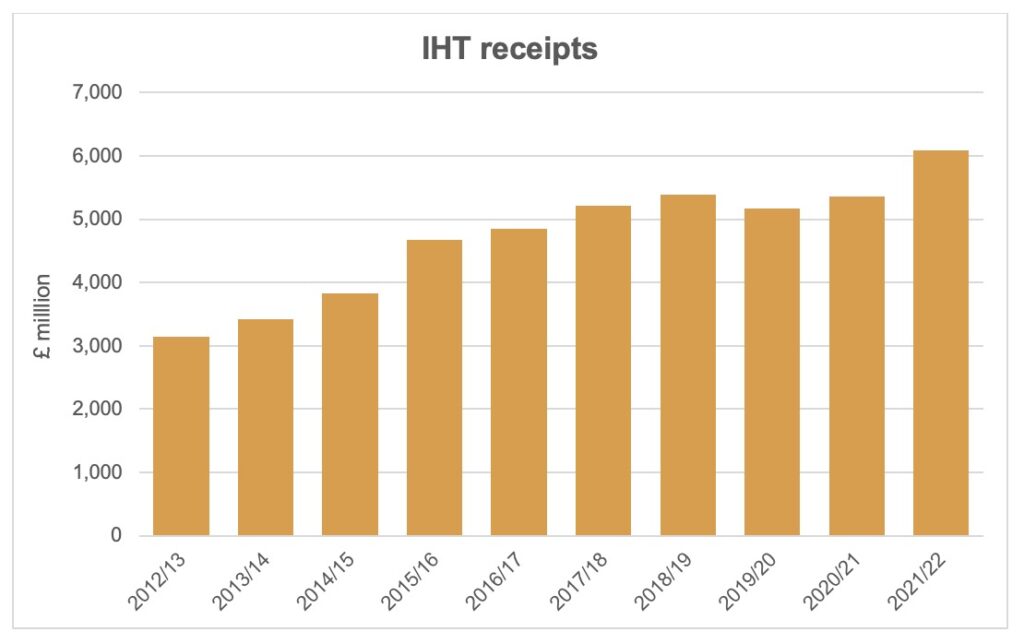
New data from HMRC show the Treasury’s inheritance tax (IHT) receipts have doubled since 2012/13.

Source: HMRC.

Of all the various taxes levied in the UK, IHT is one of the most peculiar:

  • For a start, its name is misleading. In other countries that levy inheritance taxes, the tax is usually based on the inheritor and the amount that they inherit. In the UK, the tax would be more accurately described by its former name, capital transfer tax. Think tanks regularly suggest IHT should change from a levy on donors to a tax on recipients. In theory, the switch would encourage a wider distribution of assets. It could also raise considerably more revenue.
  • IHT is often described as the UK’s most hated tax. However, the amount of tax it raises for the Exchequer is small change: it is worth about 1% of the total produced by the three main taxes – income tax, national insurance (yes, that is a tax) and VAT.
  • The great majority of estates do not pay any IHT. For married couples and civil partners who are homeowners with children, IHT is usually not an issue until their wealth exceeds £1 million. Statistics from HMRC show that in 2019/20, only 3.76% of estates suffered the tax. In practice, nearly half of estates will escape IHT simply because there is generally no tax on transfers between married couples and civil partners. However, this exemption does not apply to unmarried couples – in IHT there is no such concept as a common-law spouse.

New figures from HMRC show that in 2021/22 the IHT receipts rose by nearly 14%, with the average IHT bill faced by that small minority of taxpaying estates with a value of just over £250,000. One reason for the increase is the fact that the nil rate band is frozen. The freeze started in 2009 and its term has regularly been extended – the “thaw” is not now due to arrive until April 2026. With inflation surging, over three more years of freeze will drag more estates into the IHT net.

If IHT is a concern for you, there are a variety of ways to reduce its impact on what your children or grandchildren will inherit. It will not surprise you to learn that with such a misunderstood tax, the starting point is professional advice.