Capital gains tax receipts

Raising tax rates is a traditional government strategy to increase tax receipts for HMRC, but this may not be the case for capital gains tax (CGT). This is because taxpayers generally have more control over when gains are realised.

The upcoming Budget at the end of October is widely expected to see a hike in CGT rates. However, recently published data from HMRC suggests that the 4% higher rate reduction from 6 April 2024 (28% down to 24%) on residential property disposals may have helped to increase tax receipts as landlords could be taking a good opportunity to sell up.

For the five months to 31 August 2024, CGT receipts increased by nearly 10% compared to the year before.

Take care to plan ahead

Compared to landlords, those with an investment portfolio have more opportunity for CGT planning since they have considerable flexibility over the timing of disposals. However, there is now somewhat less scope for basic CGT planning with the annual exempt amount cut to just £3,000:

  • With an investment portfolio, disposals can be spread over several years to make use of multiple annual exempt amounts and basic rate tax bands. Couples can also make use of the annual exempt amounts and basic rate tax bands of a spouse or civil partner. Such strategies should be used with care, however, as this type of planning will unravel if CGT rates increase in the future.
  • Making personal pension contributions in the same year as a disposal will increase the basic rate tax band.
  • More sophisticated investors might consider investing in a seed enterprise investment scheme. With 50% income tax relief and CGT exemption on 50% of a reinvested gain, a landlord could currently benefit from total tax relief of 64%. This relief will increase in line with any future uplift of CGT rates. These investments are high risk and advice should be taken before engaging in them.

Longer term, those with a large investment portfolio might be able to avoid any tax liability if they retire overseas. This option does not work for landlords because UK property remains subject to CGT regardless of the owner’s residence status.

HMRC’s guide to capital gains tax (what you pay it on, rates and allowances) can be found here.

 

How to raise £10,000,000,000

With a ‘black hole’ of £22 billion to fill, there are plenty of groups giving Rachel Reeves advice.

The Fabian Society published a report on taxation on August Bank Holiday Monday. While their main audience is in Scotland, which has its summer bank holiday at the start of August rather than at the end, the timing was unusual. Nevertheless, that was the date chosen by the Fabian Society to release Expensive and Unequal. The case for reforming pension tax (2024).

The Fabian Society is one of the Labour party’s original founders and remains an affiliate to this day. Like several other left-leaning think tanks, post-election what it says has suddenly started to attract more attention. This is especially true on the issue of tax ahead of the Budget on 30 October.

The Society’s pension proposals are wide-ranging, but all of them have appeared before in one form or another. Taken together, the Society suggests that they could raise £10 billion a year. To put that in context, the controversial decision to means-test Winter Fuel Payments will save about £1.5 billion a year in 2025/26.

The most significant element of the proposals is the introduction of a flat rate tax credit to replace income tax relief on pension contributions. This idea was once allegedly considered by George Osborne, the former Conservative chancellor. For example:

  • At present, a higher-rate taxpayer (42% in Scotland, 40% elsewhere in the UK) pays £60 (£58 in Scotland) to add £100 to their pension.
  • Alternatively, the Fabian Society suggests a personal contribution of £75 from net income would receive a £25 government tax credit, bringing the total to £100. This is similar to a Lifetime Individual Savings Account.

Such a reform would benefit most taxpayers, who would see the net cost of their pension contributions drop. It would also reduce the tax benefit given to higher and additional rate taxpayers, who according to the most recent HMRC calculations (for 2022/23) receive just over half of all pension contribution tax relief.

Most of the Fabian Society’s tax-raising ideas were likely already under consideration by the Treasury. Regardless of whether they are included in the Budget on 30 October, they are worth noting if you are contemplating topping up your pension.

Find out more about the Fabian Society’s report here.

Capital gains tax: a minority sport?

Will increased capital gains tax (CGT) mean less tax gets paid?

The Labour Party’s 2024 manifesto said, ‘We will not increase National Insurance, the basic, higher, or additional rates of Income Tax, or VAT.’ The absence of any comment on CGT meant that Rachel Reeves received persistent questions during the election campaign about a possible increase. Unsurprisingly, there was no definitive answer.

At the beginning of August, HMRC published new data about how much CGT had raised. The figures were for 2022/23, when the annual exemption was £12,300 of gains, as opposed to the current £3,000. Nevertheless, they provide some interesting information about who pays how much:

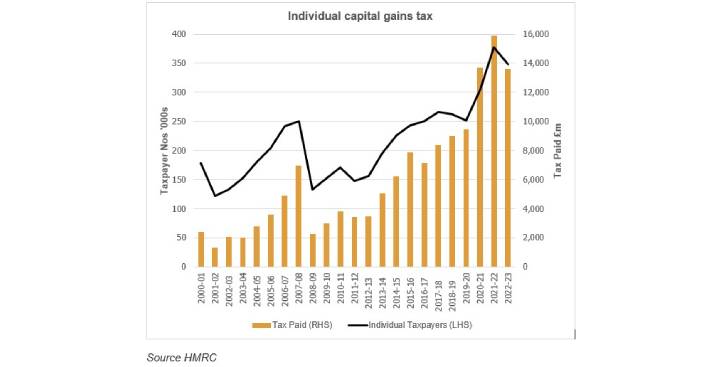
  • Only 348,000 people made enough capital gains to pay the tax. That is about 1% of the number of income taxpayers.
  • The total amount of CGT paid by individuals was £13.63 billion, with trusts accounting for another £0.797 billion.
  • 2,000 taxpayers – less than 1% of all CGT payers (who realised at least £5 million of gains) – paid 41% of all CGT collected from individuals. Another 4,000 taxpayers with gains between £2 million and £5 million paid 16% of the total.
  • There was more tax paid in the previous two tax years. Between 2021/22 and 2022/23 the Exchequer’s receipts fell by 15%.

That final bullet point deserves an explanation, because it is unusual for tax receipts to fall year-on-year, yet alone for two years. In July 2020, the then chancellor Rishi Sunak, commissioned the now-defunct Office of Tax Simplification (OTS) to review CGT. The move prompted speculation that CGT would be increased, a sentiment that was reinforced when the OTS suggested aligning CGT rates with income tax and sharply reducing the annual exemption. The predictable result was a pre-emptive rush to realise gains, boosting CGT payments.

In the event, Mr Sunak ignored the OTS proposals, although subsequently one of his many successors did take up the idea of cutting the annual exemption. As we wait to see what will be in Rachel Reeves’ Budget on 30 October, the story of CGT receipts may have provided her with an interesting lesson: hints of raising the tax are enough in itself to generate extra revenue.