

Pension scams warning

Pensions

Anyone confused or anxious about the inheritance tax (IHT) changes being introduced for pensions needs to be aware that scammers might try to target their savings.

Changes to pensions

From 6 April 2027, inherited pension funds will be subject to IHT unless inherited by a spouse or civil partner. Not surprisingly, scammers are using the change as an opportunity to target your pension savings. The scam works by offering a ‘safe haven’ overseas for your pension savings. Two problems here: one is quite important, but the second is more serious:

  • First problem: For anyone who is a long-term resident in the UK, moving a pension fund overseas will not affect the IHT position because worldwide assets – including overseas pension funds – are included as chargeable assets for UK IHT purposes.
  • Major problem: Whether the tax planning works or not is irrelevant as the fraudster will simply plunder your pension fund.

The scams you need to know

Pension scams are becoming increasingly sophisticated, with scammers using artificial intelligence (AI) and deepfake technology to make the scam appear more convincing. There are several red flags to watch out for:

  • The first warning should be if the initial email, call or message comes unexpectedly. Cold calling about pensions is illegal, so you should treat any unsolicited approach with suspicion.
  • Along with the ‘IHT saving’, the scammer will tempt you with the higher returns available if funds are moved.
  • The scammer will want to apply pressure by saying you only have a limited amount of time to accept their offer.

A scammer wants their victim to act impulsively and alone; they definitely don’t want them to obtain professional advice.

Should you agree to transfer your funds, the scammer will often provide coaching on how to circumvent your pension provider’s safety rules: for example, by providing an answer as to why funds are being moved.

The old adage of ‘it sounds too good to be true’ is invariably true in these cases, so any approach should be treated with extra caution.

The Financial Conduct Authority’s online tool to check whether a company is authorised or not is available here.
What goes into the tax cocktail?

tax cocktail

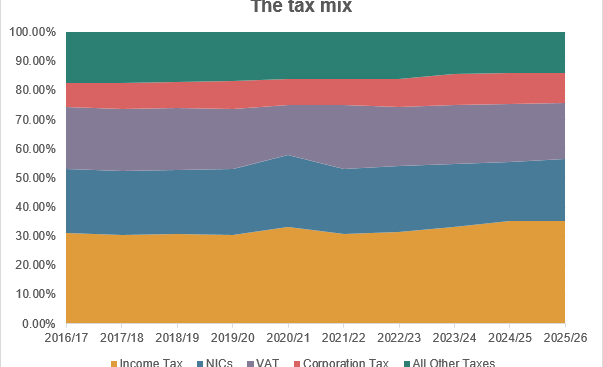
New data from HMRC shows how much the government relies on just four taxes.

Source: HMRC

The Labour Party went into the 2024 general election with pledges on four major taxes in its manifesto:

  • “Labour will not increase taxes on working people, which is why we will not increase National Insurance, the basic, higher, or additional rates of Income Tax, or VAT.”
  • “Labour will cap corporation tax at the current level of 25 per cent, the lowest in the G7, for the entire parliament…”

At the time, the tax promises were seen as politically necessary to counter suggestions that a Keir Starmer government would operate tax-and-spend policies. However, the quadruple tax lock was widely criticised by many economists for the half decade constraint that it placed on the Chancellor in uncertain times.

Fast forward about two years from the publication of that manifesto, and the economists have been vindicated. New data from HMRC, published at the end of April, showed that in the past tax year, income tax, national insurance (NI), VAT and corporation tax accounted for 86% of all tax receipts. That is not surprising – as the graph shows, over the past ten years, the quartet account for more than £4 out of every £5 tax collected.

Despite the manifesto promise, income tax receipts rose by 9% in 2025/26 from the previous year – faster than the growth in prices or the UK economy. That outpacing is due to the freezing of the personal allowance and tax thresholds, dragging more people into tax and more existing taxpayers into higher tax bands.

NI receipts grew even faster – 16.3% up – thanks to the manifesto-challenging changes to the level of employer’s NI contributions. Together, NI and income tax – the two taxes on earnings – accounted for 56.5% of all that flowed into HMRC’s coffers.

The jumps in taxes on earnings contrasted with the growth in the third largest source of tax, VAT, which grew by 5.7%. Corporation tax had even slower growth (4.6%), but that might be because employers claimed more tax relief on those higher NI contributions.

The dominance of the big four manifesto-locked taxes explains why the Chancellor has made so many tweaks to the overall system to raise additional revenue. Be prepared: it is beginning to look like that process will be repeated at the next Budget.

For HMRC’s latest bulletin on tax receipts and NI contributions, visit here.