
Approved mileage rate hike

Mileage

The Chancellor has announced a 10p per mile increase for the tax-free mileage rates, which can be paid to employees using their own cars for business purposes, with the increase backdated to 6 April 2026.

Mileage rates

The 10p per mile increase only applies to the first 10,000 business miles driven each tax year. This means that the rates to be reimbursed by employers to employees using their own vehicles for business mileage are now:


Vehicle

First 10,000 business miles each tax year

Subsequent business miles each tax year

Cars and vans

55p

25p

Motorcycles

24p

24p

Bicycles

20p

20p

For car and van trips, an employee can also be reimbursed an additional 5p per mile per passenger, so 70p per mile in total if three passengers are carried.

E-bike riders should be paid the bicycle rate for an electrically assisted pedal cycle, and the motorcycle rate for any other electric bike:

  • Where an employee uses more than one car for business mileage during the tax year, the 10,000 limit applies across all cars used; it is not per car. So, if 4,000 business miles are driven in one car for the first three months of 2026/27, with 9,000 driven in another car for the other nine months, the maximum tax-free reimbursement is 10,000 miles at 55p, plus 3,000 miles at 25p, which is £6,250.
  • Any reimbursement in excess of the approved rates for the tax year overall is treated as earnings and subject to tax.

When it comes to National Insurance contributions (NIC), the NIC-free rates are similar, except that 55p per mile can be paid for every business mile driven in a car or van; there is no 10,000-mile cut-off.

Other uses

Employees who are not reimbursed with the maximum mileage rate can claim tax relief on the difference between the rate and what they were reimbursed. An employee can therefore claim the full 55p/25p per mile car rates if the employer makes no reimbursement at all.

Sole traders and partnerships can use the mileage rates for cars, vans and motorcycles when working out their vehicle expenses to be deducted in calculating trading profits. The same applies to unincorporated landlords when calculating property income. However, in both cases, there is no additional allowance for passengers carried.

HMRC guidance on business travel mileage for employees’ own vehicles can be found here.
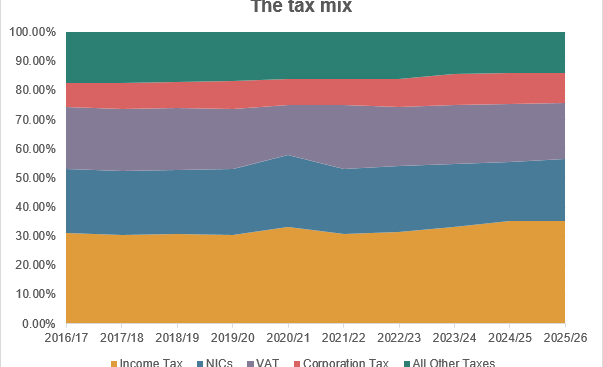
What goes into the tax cocktail?

tax cocktail

New data from HMRC shows how much the government relies on just four taxes.

Source: HMRC

The Labour Party went into the 2024 general election with pledges on four major taxes in its manifesto:

  • “Labour will not increase taxes on working people, which is why we will not increase National Insurance, the basic, higher, or additional rates of Income Tax, or VAT.”
  • “Labour will cap corporation tax at the current level of 25 per cent, the lowest in the G7, for the entire parliament…”

At the time, the tax promises were seen as politically necessary to counter suggestions that a Keir Starmer government would operate tax-and-spend policies. However, the quadruple tax lock was widely criticised by many economists for the half decade constraint that it placed on the Chancellor in uncertain times.

Fast forward about two years from the publication of that manifesto, and the economists have been vindicated. New data from HMRC, published at the end of April, showed that in the past tax year, income tax, national insurance (NI), VAT and corporation tax accounted for 86% of all tax receipts. That is not surprising – as the graph shows, over the past ten years, the quartet account for more than £4 out of every £5 tax collected.

Despite the manifesto promise, income tax receipts rose by 9% in 2025/26 from the previous year – faster than the growth in prices or the UK economy. That outpacing is due to the freezing of the personal allowance and tax thresholds, dragging more people into tax and more existing taxpayers into higher tax bands.

NI receipts grew even faster – 16.3% up – thanks to the manifesto-challenging changes to the level of employer’s NI contributions. Together, NI and income tax – the two taxes on earnings – accounted for 56.5% of all that flowed into HMRC’s coffers.

The jumps in taxes on earnings contrasted with the growth in the third largest source of tax, VAT, which grew by 5.7%. Corporation tax had even slower growth (4.6%), but that might be because employers claimed more tax relief on those higher NI contributions.

The dominance of the big four manifesto-locked taxes explains why the Chancellor has made so many tweaks to the overall system to raise additional revenue. Be prepared: it is beginning to look like that process will be repeated at the next Budget.

For HMRC’s latest bulletin on tax receipts and NI contributions, visit here.

The ‘mansion tax’ and property prices – what’s to come?

Mansion

Further details have emerged about the potential impact of the ‘mansion tax’ announced in the last Budget.

Rachel Reeves’ first two Budgets have so far featured announcements of tax-raising measures with delayed starting dates. For example, the controversial changes to inheritance tax (IHT) business and agricultural relief emerged in October 2024, but have only just taken effect. Similarly, bringing pensions within the scope of IHT was announced at the same time, but will not commence until 6 April 2027.

In her Autumn 2025 Budget, she set out plans for a High Value Council Tax Surcharge (HVCTS – aka ‘mansion tax’) on homes valued at £2 million and above, to start in April 2028. There was little detail about the measure, but a consultation was promised “in the New Year”. So far, nothing has been published by the Treasury, but just before Easter, the Office for Budget Responsibility (OBR) set out its assessment of the new tax’s impact. These included some interesting nuggets:

  • By 2028, the OBR thought the full value of the future HVCTS liability would be reflected in property prices. Although the OBR did not spell out the numbers, what this means in practice is that for every £1,000 of consumer price index (CPI)-linked HVCTS annual charge, the OBR expects a property’s value to drop by about £35,000. For the lowest £2,500 charge covering properties valued at £2–2.5 million, their value would drop by about £87,500, according to OBR theory.
  • The OBR forecasts that there will be a bunching of prices just below each threshold, which would further lower prices for properties that would otherwise be just above a threshold. The OBR is on solid ground with this assumption, as it is exactly what happened when a single stamp duty rate was based on a house’s price.

Property value in 2026

HVCTS in 2028/29

£2m to £2.5m

£2,500

£2.5m to £3.5m

£3,500

£3.5m to £5m

£5,000

£5m +

£7,500

  • One-in-five property owners (who are liable to the tax, rather than the occupiers) are expected to lodge an appeal, with a 40% success rate.

Perhaps the most telling point is that the new tax would initially raise only £400 million in 2028/29, hardly even a rounding error in Treasury accounting terms. Almost the same sum could have been generated by raising the standard rate of VAT from 20% to 20.04%, although the politics would have been much trickier.

We’ll have to wait and see if the OBR’s expectations pan out. Read more on HVCTS here.